

It’s time again for this writer’s linkup hosted by Christine Smith! She runs this fun questionnaire every single year to get writers excited about their projects (and it helps everyone find new blogs and writer friends too). And—she has created a cozy alternative to NaNoWriMo called FicFrenzy that runs from October 15th to November 15th (so you’re done with your book before the holidays hit). Check out her blog and newsletter if you want to learn how to join!
But back to Know the Novel. This linkup is a series of 10 questions to help you get to know your novel better and share it with friends and future readers! The project I’m working on this FicFrenzy season is The Tale of Plum Blossom, a Rapunzel retelling set in Japan.
So obviously, I missed the deadline for the October linkup. Buh. Regardless, I’m filling it out to introduce my novel and have fun!
THE QUESTIONS
1. What first sparked the idea for this novel?
A combination of binge-watching Japanese history videos and two weeks of eleven-and-a-half-hour shifts. Each weekday.
Okay, to explain: I used to work at our local dry cleaners, and I often played music or a video on my phone while I checked clothes for stains, emptied pockets, undid buttons and zippers, that kind of laundry prep. One favorite Youtube channel I listened to featured Japanese history and folktales and cultural details, and many of those details became fixed in my mind.
In May 2023, my coworker needed surgery and a few months’ recovery time, and store management did not have the extra personnel to cover either the morning shift (my coworker’s) or the afternoon shift (mine) for the first couple of weeks. Plus, we were understaffed already. Long story short, I was scheduled to work both shifts every day for two weeks and train the two new workers as well. And because I have chronic fatigue and various health problems, this schedule was…not ideal.
However, shortly before those two weeks, the idea of a Rapunzel/Heian Japanese story popped into my mind—a lot of cultural norms of the Heian era would explain why a beautiful lady would be so secluded with such long hair. And something about the idea grabbed me and would not let me go. It gave me something to think about and plan for before those all-day shifts, and the story turned out to be a lifesaver! That first week, in between serving customers, checking clothes, and training the new girls, I jotted notes for the plot and outline in a black notebook. The following week, I drafted the character profiles in the notebook. And on June 1st, I actually began to write the story.
2. Share a blurb (or just an overall summary)!
Hiroto, the youngest son of a provincial governor, wants a place and a purpose in the world and wanders his new home to find something of interest. Ume, isolated to study since she was small, longs for a friend and for someone to love. When Hiroto stumbles across a mysterious house on a cliff that hosts a more mysterious woman, they strike up a friendship. Her loneliness inspires him to reach out; his knowledge interests her. As they grow closer, they realize they might find their desires in unlikely places—but Hiroto’s family is critical of his decisions, and Ume’s aunt has definite plans for the girl.
3. Where does the story take place? What are some of your favorite aspects of the setting?
It takes place in Heian Japan—this period was about 400 years long, and I’m thinking my story takes place in the early era rather than the later years (detailed research still pending).
One of my favorite aspects is the visuals and aesthetics. Heian Japan was big into making everything, from letters to clothes, look good, and it’s fun to imagine all those lavish details! The nature-y areas surrounding the houses and towns are also a favorite part of the setting—some of the visuals of this story are inspired by the Studio Ghibli film The Tale of the Princess Kaguya (also my friend’s mom bought me the artbook recently, and I’m still drooling over it!)
4. Tell us about your protagonist(s).
The story is divided between Ume and Hiroto. Hiroto is the youngest son of a provincial governor; he has no hope of rising through the ranks, and his family has no plans for him, leaving him feeling ignored and left out. He does not know how to go about finding a purpose for his life and sticks to investigating whatever has captured his interest.
Ume is a young lady of fine education who is training to be the perfect noblewoman, but she has been mostly alone for as long as she can remember (visits from her aunt don’t always count). She wants to learn more about the noble life in the capitol to improve her skills and please her aunt—but her aunt won’t take her there, stay more than a day, or let her have a companion from the capitol. So Ume takes the chance to do her own research when a strange young man finds her home.
5. Who (or what) is the antagonist?
Ume’s aunt, Noriko. Here’s a line from the prologue: “Once, there was a woman named Noriko, who would have calculated and controlled every detail of her life—if she could.”
As such, she has plans for Ume…
6. What excites you the most about this novel?
Developing the relationships between the characters and fleshing out their personalities so that their actions create the fairy tale story beats. Hiroto is bored with his life and exploring, and that’s how he stumbles across the mysterious house on a cliff; Ume wants to see Hiroto again because he has information she might need; Ume is being isolated by her aunt for a specific reason.
7. Is this going to be a series? standalone? something else?
It is a standalone (although I love the idea of retelling various fairy tales in other cultures—the folktale of Urashima Taro reimagined in a Celtic culture, for example).
8. Are you plotting? pantsing? plansting?
Definitely plotting. Imagine my shock when I read over the handwritten draft and realized that I’d skipped nearly all the foundational story building blocks: establishing the settings, the character’s internal conflict, the stakes, just about everything.
Oops. Part of the problem is that I didn’t have much planning time before I started that first draft. Nor did I have much time to really think about the story—about the only available time to write was at the dry cleaners in between customers. So naturally, that store had the busiest season that I can ever remember. I took to visiting Barnes & Noble, which was just down the road from my church’s location at the time, to write on Sunday afternoons. It was quite nice, even if I was brain dead from the work week and still didn’t have much thinking time.
This time around, however, I have drafted a solid outline and have time brainstorm before my writing sessions!
9. Name a few unique elements in this story.
Well, Ume is the kind and softspoken sort, and that’s a personality type I haven’t seen in modern stories lately. She’s also sheltered but not an idiot and can read her aunt’s moods well.
A lot of key aspects of the Rapunzel fairy tale actually fit quite well in Heian culture. Ladies were often isolated in their quarters (but not as isolated as the Rapunzel character); long hair was a sign of feminine beauty (although Rapunzel-length hair would be extreme even for that time); it wasn’t unusual for couples to visit each other secretly while courting, and so Hiroto has an excuse to go out everyday to visit. Although his family might not accept his courting whom they think is a low-born country girl…
10. Share some fun “extras” of the story (a song or full playlist, some aesthetics, a collage, a Pinterest board, a map you’ve made, a special theme you’re going to incorporate, ANYTHING you want to share!).
I definitely have a Pinterest board! Any new story or character that captures my imagination must have a Pinterest board. Visuals are important! (It irks me that some of the character and setting inspiration on the board is Chinese, not Japanese, but it matches how I picture expressions, poses, stuff like that.)
Here’s a quick sketch of Ume:
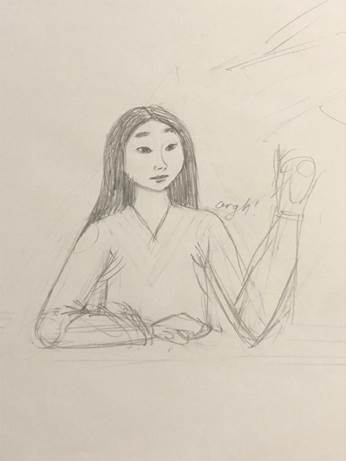
Note my artist frustrations in the negative space. 😊
Here’s a banner? intro picture? header? for the story. It’s not meant as cover art; I have a different design in mind for that, but this drawing communicates a lot of the aesthetic of the story:

And fun fact I learned while working on this drawing: Japanese inkstones are sometimes a different shape than Chinese inkstones. I used my own inkstone from a Chinese calligraphy set as reference, and halfway through the drawing, I thought to look up some pictures for more reference. Lo and behold, two different shapes were presented in the image search results. So I looked up “Japanese inkstones” and all the search results presented a stone with a more rectangular with a slope for grinding the ink stick back and forth. While this was intriguing to discover, I sadly erased my (very well-drawn) square inkstone and re-drew it properly. The things we do for art…
Fun fact number two: I’m suddenly not sure about that conclusion anymore. I looked up the inkstone shapes again in preparation for this post and found both rectangular and square inkstones in the search results for “Japanese inkstones” and “Chinese inkstones”. The articles I looked at didn’t specify a difference between the two. This is also after the implementation of AI in Google searches, so I’m not sure if something changed or if I didn’t research thoroughly enough the first time!
So that was Know the Novel Part 1! Thank you for reading! Now to see if I can get Part 2 done before the end of November…


 The Freelance Dragon
Leave a reply to Christine Eyre Cancel reply